
Lorain County Projected Release Dates
A projected or scheduled date is a calculation based on the record as it stands. An actual Release Date is the timestamp showing that a named custodian completed the departure. Lorain County's Tyler jail detail can display both Scheduled Release Date and Release Date. ODRC uses the combined label Expected Release Date/Parole Eligibility Date, and may also display a POA/PRD Date. Those state labels require careful reading because one can mark the point when parole consideration becomes possible rather than the day a person must leave prison.
Pretrial custody works differently. A person held while a case is pending may leave after bond, recognizance, dismissal, a court order, or another legal change. There may be no fixed release date to calculate. Even after bond posts, another case, detainer, or transfer order can keep custody in place. The Lorain County jail's actual timestamp and all charge dispositions must be checked before treating a scheduled date as complete.
The custodian-specific limit matters. A departure from Lorain County Jail may be a transfer to ODRC, the Lorain/Medina CBCF, another county, or another agency. It should not be called community release until the destination is known. Likewise, an internal move from Lorain Correctional Institution to another state prison is not release from ODRC.
Note: An actual Lorain County jail timestamp proves departure from that jail, but not release from every possible custodian.
Find Lorain County Release Dates
The right search depends on whether the person has a county booking, an Ohio prison record, or only a pending court case. Searching one system can produce a false negative. A person who served only a county-jail term may never appear in ODRC. A person conveyed from Common Pleas to state prison should be followed from the court docket into the state offender record.
- For Lorain County Jail, open the Tyler Inmate Inquiry. Search by name, subject number, or booking number and leave In Custody unchecked.
- Open the correct booking. Compare Scheduled Release Date with the actual Release Date, charge dispositions, bonds, court, docket, and any transfer information.
- For an Ohio prison term, search the ODRC Offender Search by surname or offender number. Read Status before any date.
- Review Expected Release Date/Parole Eligibility Date, POA/PRD Date, Parole or Release Detail, hearing month and result, and supervision fields together.
- Use the Common Pleas docket for the sentence, jail-time credit, judicial-release order, appeal, correction, or later case event.
- When the online record is incomplete, ask the Sheriff Records Division for county calculations or ODRC Central Records for the state calculation and release record.
A broader explanation of county booking history and release records appears on the Lorain County released-inmate search page. For this lookup, the decisive practice is to pair a date field with current status and the authority that produced it.
Lorain County ODRC Release Fields
ODRC Offender Search is the central route for Ohio prison and APA records. Search results may be narrowed by commitment county, residential county, status, ZIP, hearing month, or offender number. The individual result can include admission date, institution, sentence data, jail-time credit, expected or eligibility date, next board review, latest board outcome, POA/PRD, supervision start, period, and assigned APA office.
| ODRC field | How to read it |
|---|---|
| Status | Incarcerated means prison custody continues. APA Supervision means state supervision outside prison unless a violation status applies. Released is a separate status. |
| Expected Release Date/Parole Eligibility Date | A projected release date or a date pending parole consideration, not a guaranteed exit. |
| POA/PRD Date | POA means parole on or after. PRD means projected release date. |
| Parole or Release Detail | Populated after release or parole and blank while incarcerated, according to ODRC definitions. |
| Next hearing and latest result | Board timing and action for cases that require parole consideration. |
| Supervision fields | Start, period, office, and possible end information after state release. |
The official ODRC definitions page is the source for those labels. Its successful capture shows why the combined date label cannot be shortened to a firm release date.
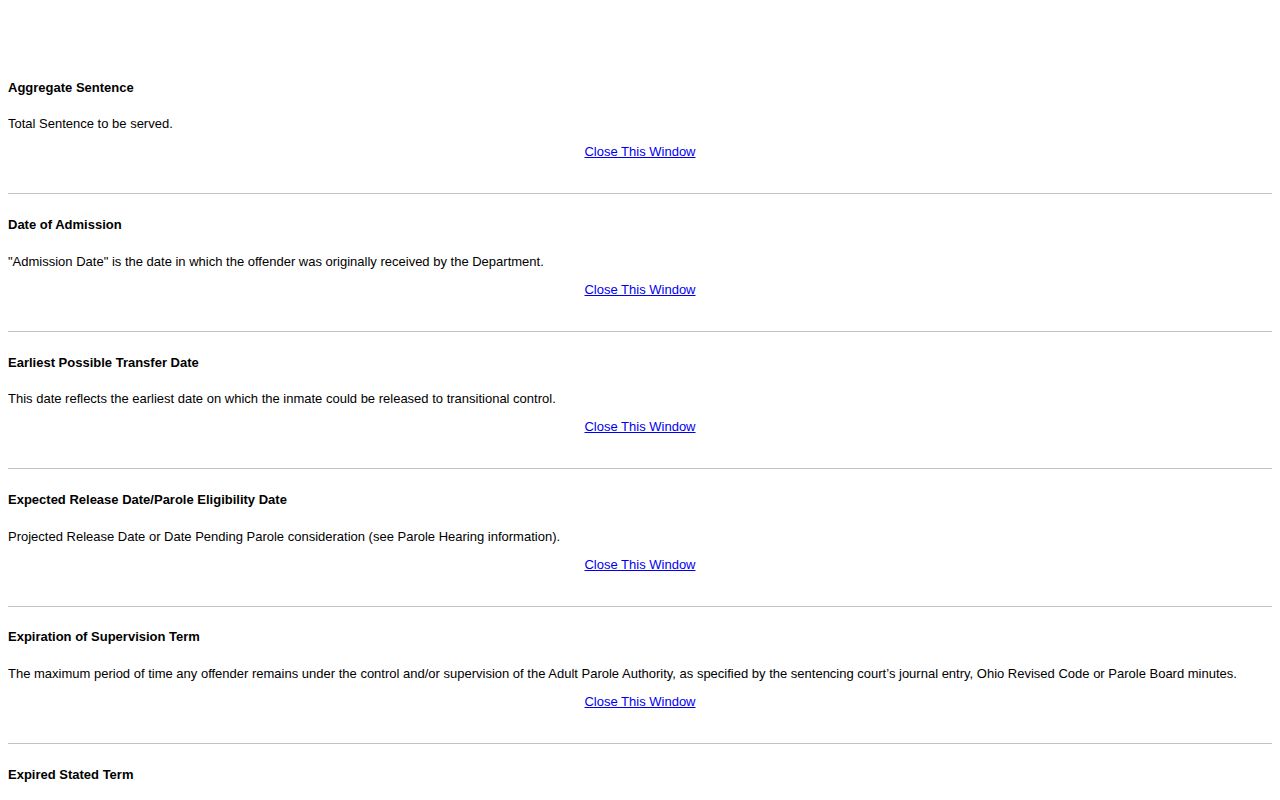
The definitions provide the context needed to distinguish present incarceration, a future board review, APA supervision, and final release.
Note: ODRC warns that sentence information may be incomplete, so a court entry and Central Records response can resolve a conflict.
Lorain County Release Date Calculation
An Ohio prison date is calculated in layers. First identify the offense date and sentence type. Then aggregate concurrent and consecutive terms, apply court-certified jail-time credit, separate mandatory or non-reducible time, and apply only credit for which the person is eligible. Parole cases require board consideration. Qualifying modern non-life indefinite sentences require the presumptive-release framework. ODRC then displays the current status and dates based on the record in its custody.
ORC 2967.191 governs court-certified jail-time credit. Current productive-participation credit is addressed by ORC 2967.194, with implementation and ineligible terms in the related Ohio administrative rules. Credit is not automatic. Eligibility, completed activity, conduct review, mandatory time, offense category, and the sentence era all affect the result.
Modern non-life indefinite terms add another layer. For many qualifying first- and second-degree felonies committed on or after the statute's effective date, the reduced minimum can be the presumptive release point. Under ORC 2967.271, ODRC may continue incarceration after required findings, but not beyond the maximum term. That structure is distinct from old-law discretionary parole.
The current earned-credit law is shown in a successful project capture. Review the current Ohio earned-credit statute before using a percentage in any Lorain County release date calculation.
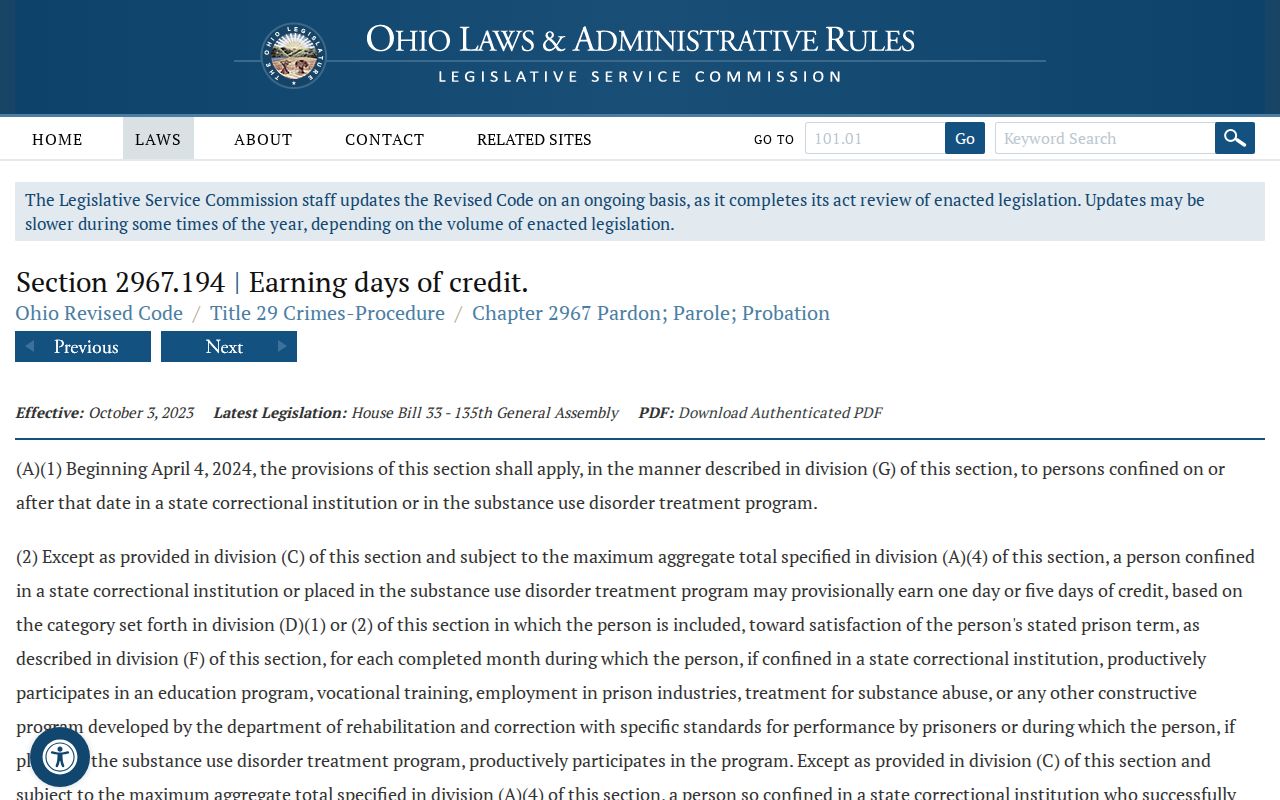
The statute shows that credit depends on defined participation, caps, exclusions, and final approval rather than a single automatic deduction.
Lorain County Earned Credit Limits
Ohio's current ordinary earned-credit cap can reach fifteen percent for an otherwise eligible term. That arithmetic is the source of an “eighty-five percent” shorthand, but Ohio does not impose one blanket promise that every incarcerated person will leave after serving that share. Monthly accrual, completed programs, finalization, disciplinary review, statutory exclusions, mandatory time, serious or life offense categories, and sentence-era rules can all reduce or eliminate credit.
Parole and Reagan Tokes cases also resist the shorthand. An old-law or life case can reach an eligibility date and still await a board decision. A qualifying modern indefinite case can reach a presumptive point while the statute permits continued incarceration after findings. A county-jail sentence is separate again. No official blanket Lorain County jail good-time percentage or weekend-release rule was found, so ODRC credit law must not be imported into a local jail calculation.
Lorain County Release Date Changes
A projected date can move when the legal or correctional record changes. Some changes reduce time, while others add custody or postpone the expected exit. The public display can also lag the formal order. Compare the most recent court entry with the current custodian's record whenever a date changes without a clear explanation.
| Factor | Possible effect | Best confirming source |
|---|---|---|
| Jail-time credit or sentence correction | Changes the term credited as already served | Sentencing court journal entry and custodian calculation |
| Earned credit awarded, denied, or withdrawn | Can shorten less time than first estimated | ODRC calculation and current credit law |
| New case, detainer, or hold | May prevent community release or cause transfer | Court, Sheriff Records, or receiving agency |
| Parole Board action | May approve, defer, deny, or alter a projected date | Individual ODRC record and official minutes |
| Judicial release | May permit court-ordered release before the original prison end | Common Pleas journal entry and ODRC detail |
| Appeal or later sentence | Can revise the aggregate calculation | Current court docket and Central Records |
A detainer is a request or legal basis for another authority to hold or receive a person. It can turn a jail departure into a transfer rather than a return to the community. A past expected date with an Incarcerated status should be treated as unresolved, not as proof that the person is free.
Lorain County Jail Release Dates
County-jail calculations do not use the same framework as an ODRC prison term. Tyler can show a Scheduled Release Date, but Lorain County Jail must apply the sentencing entry, court-certified jail-time credit, active bonds, holds, and later court orders. Research found no official blanket Lorain County good-time percentage. It also found no official weekend-release rule that can be used to shift every scheduled date. Ask the jail records office and sentencing court for the calculation instead of applying a state earned-credit cap to a county sentence.
A sentenced jail stay must also be separated from pretrial detention. The latter can end after a bond change, recognizance order, dismissal, or Court Supervised Release decision. Those events depend on a judge and the status of every case or hold. A Tyler disposition on one charge may coexist with another legal basis for custody. Read each docket number in the booking detail, then compare the journalized orders with the actual jail Release Date.
Lorain County's system preserves a useful audit trail. Results identify Scheduled Release Date and current housing, while detail can add the true release timestamp, sentence date and length, disposition, bond, court, and docket. Blank fields remain possible. If the expected calculation is missing or the destination is unclear, request the release sheet, jail movement record, and any public transfer notation from Sheriff Records.
Note: A scheduled county-jail date can change or pass without community release when another hold or transfer authority remains active.
Confirm Lorain County Release Dates
For a county record, contact the Lorain County Sheriff Records Division at 440-329-3703 and request the actual release or movement record, scheduled-date calculation, and public transfer notation. The Sheriff's online request form is available through the Public Records Request portal. Pair the response with the court order that authorized the release or transfer.
For a state record, contact ODRC Offender Search and Central Records at 614-752-1161 or P.O. Box 430, Columbus, OH 43216. Include the offender number and identify the exact field in question. Pending custody changes can also be monitored through the VINE Inmate Check, but Ohio warns that notification should not be the sole source of confirmation.
Final verification always returns to the current custodian. The Lorain County jail can certify its own departure. ODRC can certify state status and calculation. A court can certify its order. None can conclusively speak for a later receiving agency without that agency's record.